

The Skills That Define the Agentic Manager: A Complete Framework
SKILLS & PROFESSIONAL DEVELOPMENT
Creating and managing AI agents demands a rare combination of technical fluency, operational discipline, ethical reasoning, and human leadership. Here is what it actually takes — broken down by tier, depth, and priority.
Ask ten hiring managers what skills they want in an Agentic Manager and you will get ten slightly different answers. One will emphasize Python. Another will say communication. A third will insist that ethical judgment is non-negotiable above everything else. They are all right — and that is precisely what makes this role so unusual. The Agentic Manager is not a specialist. They are a generalist with deep pockets in very specific places, operating at the seam between human and machine intelligence.
The good news is that the skills required are learnable. Most of them do not require a computer science degree. What they require is a structured approach to building competency across four distinct tiers — foundation, operational, advanced, and leadership — each of which compounds the one before it.
"The person who thrives in this role isn't the best engineer or the best manager. It's the person who can think like both at the same time."
TIER 1 — FOUNDATION SKILLS
These are the non-negotiables. Without a working command of these competencies, everything else becomes guesswork. They do not require deep expertise, but they do require genuine understanding — not surface-level familiarity.
FOUNDATION: Required before deployment of any production agent
AI & LLM literacy
Understanding how large language models reason, where they fail, what hallucination means in practice, and how context windows and temperature settings affect outputs.
Prompt engineering
Designing instructions that produce reliable, repeatable results. Knowing when to use system prompts, few-shot examples, chain-of-thought, and structured output formatting.
Workflow logic
Mapping task sequences, decision trees, and conditional branches so that an agent knows not just what to do but in what order and under what conditions.
Tool & API awareness
Familiarity with how agents connect to external systems — web search, databases, code execution, file management — and what can go wrong at each integration point.
TIER 2 — OPERATIONAL SKILLS
These are the skills that turn a capable technologist into an effective agent manager. They are less about building agents and more about running them — safely, at scale, over time.
OPERATIONAL: Required for managing agents in live production environments
Performance monitoring
Reading dashboards, interpreting quality metrics, identifying output drift, and diagnosing when an agent's performance has degraded from its baseline.
Escalation design
Building the rules and thresholds that determine when an agent should hand off to a human — and ensuring those rules are calibrated to actual risk, not theoretical risk.
Failure mode analysis
Systematically documenting how and why agents fail, categorizing error types, and using that taxonomy to drive improvements in prompts, guardrails, and architecture.
Testing & evaluation
Designing test suites that stress-test agent behavior across edge cases, adversarial inputs, and high-volume scenarios before any workflow goes live.
Feedback loop management
Capturing human corrections systematically and translating them into structured improvements — whether through prompt refinement, fine-tuning requests, or architectural changes.
Documentation discipline
Maintaining clear records of agent configurations, decision logic, version history, and incident reports — the audit trail that satisfies both internal governance and external regulators.
TIER 3 — ADVANCED SKILLS
At this tier, the Agentic Manager begins operating strategically rather than purely tactically. These skills separate competent practitioners from genuinely exceptional ones.
ADVANCED: Differentiates senior practitioners from mid-level operators
Multi-agent orchestration
Coordinating multiple specialized agents working in sequence or parallel — managing handoffs, resolving conflicts between agent outputs, and ensuring the system behaves coherently end to end.
Risk & compliance mapping
Connecting specific agent behaviors to regulatory requirements, identifying where liability attaches, and designing workflows that satisfy legal obligations without sacrificing capability.
Data fluency
Interpreting statistical outputs, understanding confidence intervals, and reading model evaluation reports well enough to ask the right questions of engineering teams.
Security awareness
Understanding prompt injection attacks, data exfiltration risks, and the ways malicious actors attempt to manipulate agent behavior — and building defenses into workflow design.
TIER 4 — LEADERSHIP & HUMAN SKILLS
Perhaps the most underestimated tier. The Agentic Manager does not work in isolation. They translate between engineers and executives, advocate for responsible deployment, and carry accountability that software cannot hold.
LEADERSHIP: Essential for organizational influence and long-term impact
Ethical reasoning
Applying structured frameworks to questions of fairness, bias, and harm — not as a theoretical exercise, but as a practical input to how agents are configured and constrained.
Stakeholder communication
Translating agent behavior — its capabilities, limitations, and failure modes — into plain language for executives, clients, legal teams, and regulators who may have no technical background.
Change management
Navigating the organizational resistance that comes with replacing human workflows with AI agents — building trust, managing anxiety, and ensuring teams remain engaged rather than alienated.
Strategic prioritization
Deciding which workflows are ready for agent automation and which aren't — applying sound judgment about risk tolerance, organizational readiness, and the realistic ceiling of current AI capability.
HOW THE SKILLS ARE WEIGHTED IN PRACTICE
Across interviews with hiring managers and practitioners, a consistent picture of relative skill emphasis has emerged. Notably, the highest-demand skills skew toward judgment and governance rather than pure technical execution — reflecting the industry's current maturity level.
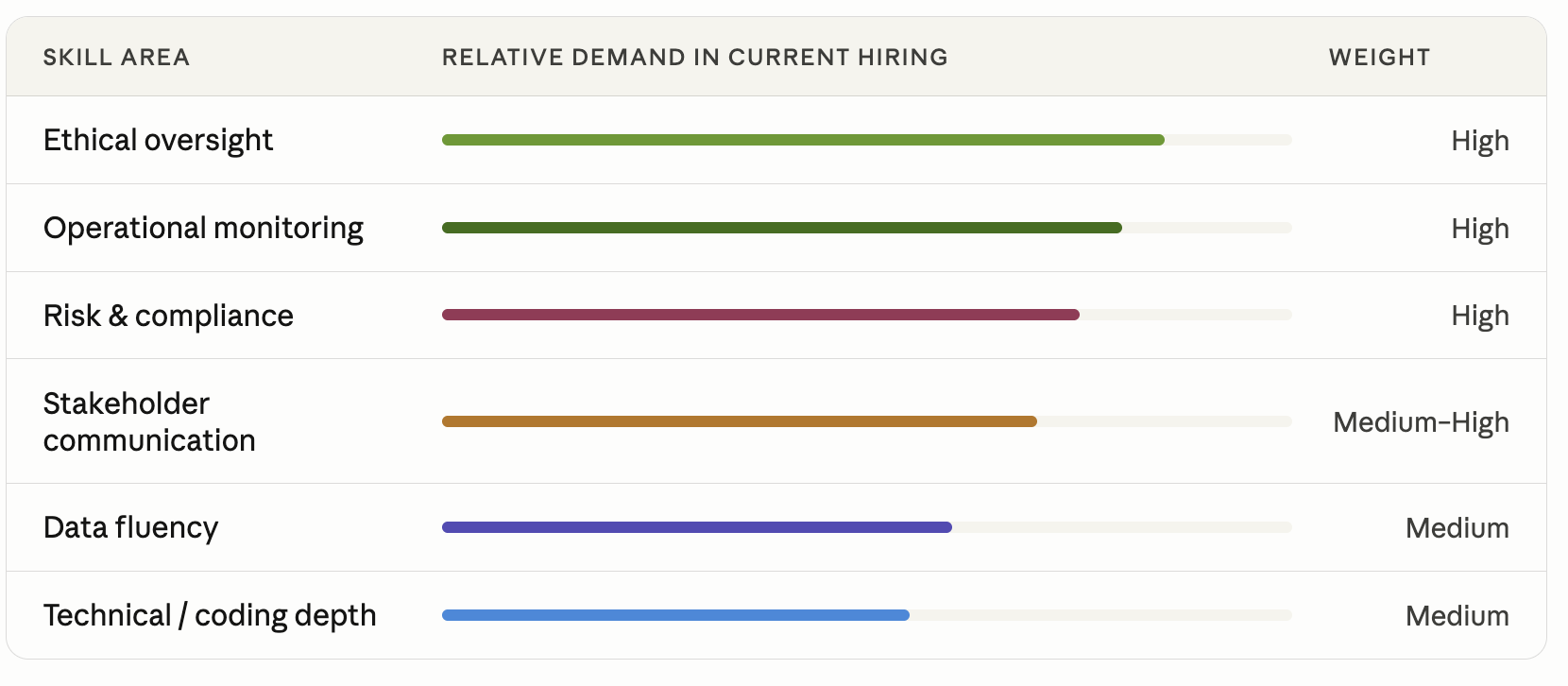
The skill weighting data carries an important implication for how professionals should invest in their development. Technical fluency matters — but it is not the ceiling that limits most Agentic Manager candidates. The ceiling is almost always softer: the ability to hold ethical complexity, communicate across organizational divides, and make sound judgment calls under uncertainty. These are the skills that separate those who manage agents adequately from those who do it with genuine excellence.
For organizations building this function from scratch, the framework above also suggests a sequencing strategy. Hire first for foundation and operational competency — these are the skills needed to keep agents running safely in the near term. Invest in developing advanced and leadership skills over the first twelve to eighteen months, as the practitioner gains direct experience with the specific agent ecosystems inside the organization. The best Agentic Managers are not found fully formed. They are built — deliberately, with the right foundation, and given room to grow.
"You don't need to write the model. You need to understand it well enough to be responsible for it — and that's a very different, and arguably harder, thing."
The Agentic Manager who invests in all four tiers of this framework will find themselves positioned at one of the most consequential intersections in modern business: the place where machine capability meets human accountability. That intersection is not going away. If anything, as agents grow more powerful and more autonomous, the person managing them will matter more, not less. The skills outlined here are not preparation for a moment. They are preparation for a career.